Pickleball in Delray Beach: Courts, Clubs, and How to Get in the Game

Few cities in South Florida have taken to pickleball as quickly or as seriously as Delray Beach. The courts fill at sunrise. The paddle queues form before most people have had coffee. On a Tuesday morning in December, you might find players from New York, Ohio, and Ontario sharing a net with year-round residents who know every bounce and wind pattern by memory. This guide covers every public court in the city - where they are, who plays there, how to get in, and what to expect depending on your skill level and how competitive you want to be.
Why Delray Beach Has Become a Pickleball Hub
The demographics help explain a lot. Delray Beach has long attracted snowbirds - retirees and seasonal residents who arrive from the Northeast and Midwest between November and April and look for active outdoor recreation. Pickleball, which rewards strategy and touch over raw athleticism, fits that population well. The Villages of Oriole, a cluster of eight 55-plus developments in Delray Beach with development beginning in the early 1970s, illustrates the dynamic clearly: the community has its own dedicated pickleball courts and a full-time activities director who organizes regular club play. That kind of built-in residential infrastructure, replicated across dozens of retirement communities throughout Palm Beach County, seeded the sport's growth here years before it went mainstream nationally.
The city's existing tennis infrastructure made the transition smooth. The Delray Beach Tennis Center had already built a world-class facility to support ATP professional tournaments. When demand shifted toward pickleball, courts could be adapted or supplemented without starting from scratch. Palm Beach County municipalities have been converting underused tennis courts to pickleball courts to meet demand - a trend that has added capacity across the region in recent years. Delray Beach now has 18 court locations total, according to the Bounce.game city directory - a combination of free outdoor courts, fee-based city-managed facilities, and private residential sites. Year-round outdoor playability compounds everything: unlike northern states where the sport shuts down for months, Delray Beach courts run every day of the year. That consistency allowed an organized club scene, a certified coaching staff, and a real tournament calendar to develop here in ways that are harder to sustain in seasonal climates.
Delray Beach Tennis Center: The Main Venue
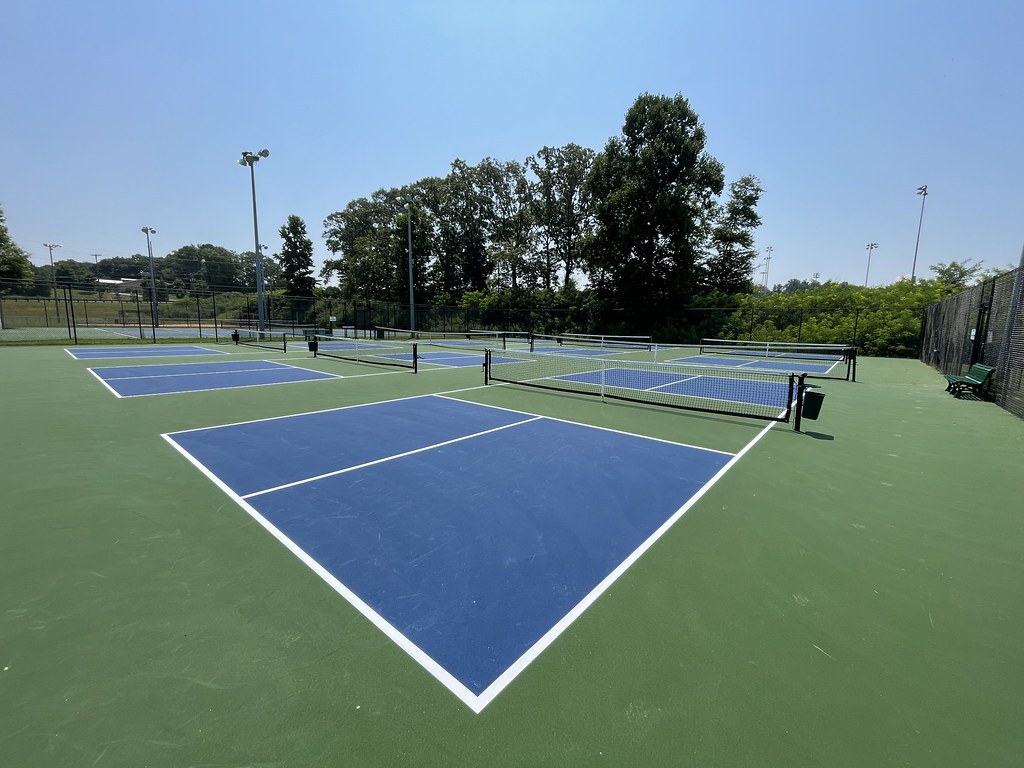
The Tennis Center on West Atlantic Avenue is the center of gravity for Delray Beach pickleball. The facility has 8 dedicated outdoor hard pickleball courts alongside 14 clay tennis courts and 4 hard tennis courts. Its centerpiece is an 8,200-seat ATP stadium - one of the few facilities in the country where recreational players warm up beside the same grandstands that host professional tennis. That context has practical implications: the surface quality, court dimensions, and maintenance standard are calibrated to professional-grade expectations, which recreational players benefit from every time they step on the court.
All eight pickleball courts are lighted, extending viable play time into the evening. The courts also use paddle-drop queuing - standard at serious pickleball venues but often confusing to first-time visitors. Here is how it works: when you arrive at a court in use, you place your paddle in a rack or designated spot near the net post to hold your place in the rotation. When a game ends, the four players who have waited longest take the court. You do not ask permission to play; you drop your paddle and wait your turn. Losing the game means you cycle out, your paddle goes back in the queue, and the next group in line steps on. Understanding this before you arrive saves awkwardness and avoids accidentally cutting the line - regulars notice both.
Open play runs seven days a week starting at 7:30am and continuing through approximately 10pm on lit courts. The city charges a per-session drop-in fee with a lower rate for residents than for non-residents, and monthly multi-site passes are available for frequent players. Check the city's parks and recreation page for current rates. Beyond the Tennis Center, the Bounce.game directory lists additional outdoor court locations across the city, including one free site; the city's parks and recreation page has current hours, fees, and reservation requirements for each. These smaller neighborhood courts draw less traffic and no round-robin crowd, which makes them a practical choice for focused skills work with a partner, and a useful fallback during peak winter weeks when Tennis Center queues run long.
Delray Beach Community Center: Indoor Courts and Advanced Play
The Community Center on Northwest 1st Avenue has 3 indoor hard courts with permanent lines and portable nets - purpose-built for the sport rather than adapted from a multipurpose gym. Regular hours run Monday through Friday from 8am to 8pm and Saturday from 8am to 4pm, covering most of the day for flexible drop-in access. Confirm current hours with the city, as schedules can shift seasonally.
The bigger draw for experienced players is the dedicated advanced open play on Tuesdays, Thursdays, and Fridays from 8am to 12:30pm. These sessions are designed for players who want higher-level competition without the mixed-skill atmosphere of general open play. If you are a 4.0 or above who has played elsewhere and wants to gauge the local competitive level, this is the right first stop.
The indoor setting matters more in South Florida than it might elsewhere. From late May through early October, outdoor pickleball is viable in the early morning, but the heat and humidity become serious factors by mid-morning. The Community Center courts hold a consistent temperature year-round. Players recovering from injuries or managing heat sensitivities often make it their primary venue during summer, rotating back to the Tennis Center once the outdoor season becomes comfortable again. The tradeoff is fewer courts and no Sunday evening hours - plan accordingly and confirm current hours with the city, as summer schedules can shift.

The Delray Beach Pickleball Club
The Delray Beach Pickleball Club is the organized spine of recreational pickleball in the city. It runs open play at the Tennis Center seven days a week, starting at 7:30am and continuing through approximately 10pm. The club's portal at dbpickle.com is where players check schedules, sign up for sessions, and track clinic offerings and special events.
The predominant skill level at club open play is 3.5 to 5.0 - most regulars are experienced, can sustain rallies, understand third-shot drops and stacking, and play at a pace that can feel fast to a newcomer. The club welcomes all skill levels, but a new player should know going in that they will likely be directed toward others at their level. Saying upfront that you are new helps - regulars and staff will usually route beginners to appropriate courts rather than drop them into a 4.5 rotation.
Drop-in fees for non-residents are set by the city; resident rates are lower. Monthly passes offer better value for anyone playing more than a few times per week. Check dbpickle.com or the city's parks page for current pricing. For a first visit, watch a few rallies before dropping your paddle in to gauge the pace. Finding the person informally managing court rotations - there is almost always one during high-traffic sessions - and introducing yourself smooths the experience considerably.
Lessons, Clinics, and Getting Better
The Tennis Center has two certified pickleball professionals on staff: Keith Kovach and Michael Krooks. Both offer private and semi-private lessons; contact information for each is available directly through the Tennis Center. The facility also runs youth pickleball camps, making it one of the few sites in Palm Beach County with a structured junior development pipeline alongside adult programming.
For intermediate players - roughly 2.5 to 3.5 skill level - the Tennis Center runs clinics on Monday and Wednesday mornings from 9 to 10am. Sessions cover movement patterns, shot selection, and court positioning. The format is drop-in rather than pre-enrolled, so you can attend once or every week depending on your schedule. The per-class fee is set by the facility; confirm the current rate when contacting the pros or checking the city's recreation listings.
The clinics focus on the areas where intermediate players tend to plateau: footwork at the transition zone, dink consistency, and resetting balls out of trouble from mid-court. These mechanics are hard to work on in open play, where the pace does not stop to break down technique. Players with a racquet-sport background often progress faster because they already read court angles, but the soft game - dinking, touch volleys, kitchen management - is largely sport-specific and benefits from directed instruction. For players who want more options, the Global Pickleball Network lists numerous pickleball coaches within the Delray Beach area and many organized leagues for structured competitive play beyond casual drop-in - check the network directly for current counts, as listings change regularly.
Tournaments and Spectating
Delray Beach's tournament calendar is more developed than most cities its size. The anchor event is the Pickleball is Life Challenge, held each March at the Tennis Center. The third edition ran March 6 through 9, 2025, drew hundreds of players across amateur and professional divisions, and distributed substantial prize money - with separate awards covering all skill levels and age brackets. Amateur players competed alongside pros on the same courts during the same weekend. Registration for future editions is tracked through the club portal and the Tennis Center events calendar.
The Delray Beach Pickleball Open and Shootout uses all 27 courts at the Tennis Center complex, including three championship courts, with matches running 8am to 8pm daily across the event week. That scale - nearly 30 courts running simultaneous matches all day - creates a spectating environment that has almost no equivalent in recreational pickleball. You can arrive without a paddle, find a seat courtside, and watch competitive play at multiple skill levels across the facility at the same time.
Attending one of these events as a spectator before entering a bracket is useful preparation. Match warm-up procedures, the flow of tournament rotations, and the general pace of a competition day are easier to absorb by watching than by reading about them. The DB Pickleball Classic rounds out the calendar with additional bracket-play windows, meaning players who want tournament experience have multiple options each year without leaving the city.
Nearby Courts Worth the Short Drive
When the Tennis Center is at capacity during peak season, three nearby options are worth knowing about before you need them.
Caloosa Park in Boynton Beach sits roughly five minutes north of Delray Beach, accessible off Congress Avenue. It has 8 lighted outdoor courts, charges no fee, and stays open until 10pm. That combination - free, lighted, eight courts, open late - makes it a genuinely useful overflow option on busy winter evenings. The courts have permanent nets and hold a solid standard for a free municipal facility. If you have not visited before, it is worth a stop.
Burt Aaronson South County Regional Park in western Boca Raton has 6 outdoor courts and is accessible from western Delray without fighting coastal traffic. The courts are free and open on a first-come, first-served basis; check with Palm Beach County Parks for current hours and whether evening lighting is available before planning a late visit. Patch Reef Park in Boca Raton has significantly expanded its pickleball facilities in recent years, including a covered pickleball complex that opened in late 2025 and brought the total court count to over 30 - check mybocaparks.org for current court availability, fees, and hours. It was the site of the 5th annual World Pickleball Open in March 2026, and that tournament history gives it a more organized-play culture than typical parks-department facilities.
Knowing these alternatives exist matters most between December and March, when peak-season demand at Delray Beach's courts is at its highest. Heading to a free option nearby rather than waiting through a long queue at the Tennis Center is a practical adjustment that experienced local players build into their regular rotation.
Seasonal and Practical Tips
The single most important thing to understand about Delray Beach pickleball is the November-through-April surge. Snowbirds arrive in volume starting around Thanksgiving, and the Tennis Center's open-play courts shift from manageable to competitive for court access within a few weeks. By January and February, weekend morning sessions see extended queue times. Weekday mornings and mid-week afternoons are measurably less crowded. The pattern is reliable enough to plan around, even if it shifts slightly year to year depending on weather up north.
For outdoor summer play, wind screens on the pickleball courts reduce direct glare and some heat exposure. Players new to South Florida outdoor sports consistently underestimate how quickly the early sessions take a toll - the Community Center's indoor option exists for exactly this reason, and many regulars rotate between the two venues through the summer months.
On etiquette: if you need to leave the court area while your paddle is in the queue, pull it and re-queue when you return - leaving an unattended paddle in the rotation is the most common source of friction at busy sessions. A 3.5-to-5.0 open-play session is not the right setting for slow-paced practice rallies; maintain pace or join an appropriate-level session instead. These norms are not posted anywhere, but they are understood by everyone who plays regularly, and violating them marks you as someone who has not bothered to learn how the venue works.
The 55-plus community scene, centered on places like the Villages of Oriole and neighboring Delray Beach developments, feeds into public court use throughout the season. These players tend to arrive early, know each other well, and have established playing groups. They are generally welcoming to newcomers who show basic court manners. The most consistent, patient pickleball you will see at 7:30am on a Tuesday in December often comes from a player who has been rotating through these courts for several consecutive winters - which, for a first-timer trying to understand the local game, is worth paying attention to.